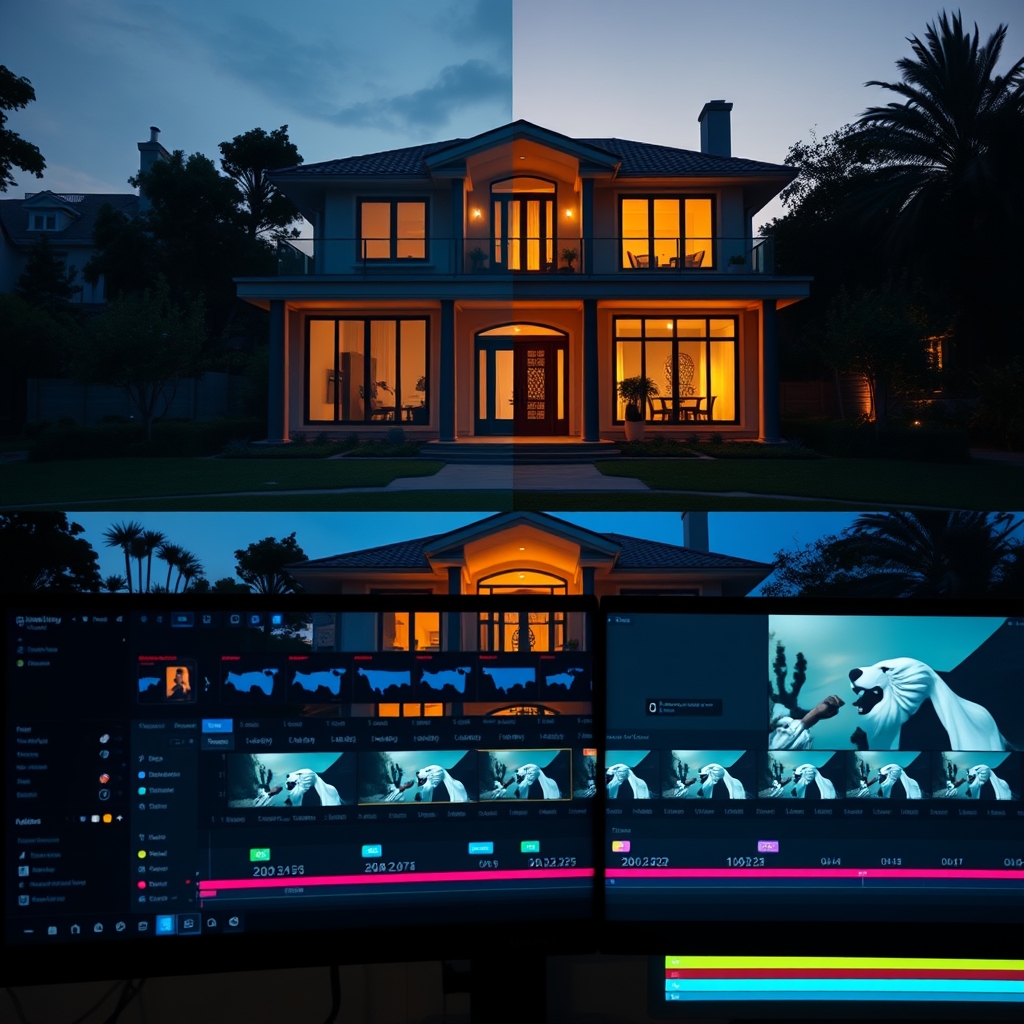
Why Day-to-Night Editing Matters for Property Tours
Day-to-night editing transforms a standard property tour into a cinematic experience. By showing a home transitioning from golden hour to twilight, you highlight exterior lighting, interior warmth, and architectural features that daytime-only footage misses. For a real estate videographer, this technique can set your work apart and justify premium pricing.
“A day-to-night transition is not just a filter—it’s a storytelling tool that makes buyers imagine living in the space at all hours.”
However, achieving a believable transition requires more than dragging a slider. It demands a structured workflow, especially for a production team handling multiple properties each week.
The Challenges of Day-to-Night Editing
Editing day-to-night footage presents unique hurdles in video post-production:
- Exposure gaps: Day shots are bright; night shots need deep shadows without losing detail.
- White balance shifts: Daylight is cool, while interior lights are warm—matching them smoothly is tricky.
- Window views: Replacing a bright daytime window with a dusk sky requires precise masking and tracking.
- Consistency across shots: A single property may have dozens of clips; all must share the same night look or the transition feels jarring.
A Complete Workflow for Production Teams
Here’s a step-by-step workflow that our team at Hoang Editor uses to deliver consistent real estate video editing for day-to-night projects.
Step 1: Shoot with Day-to-Night in Mind
The real estate videographer must capture enough data. We recommend shooting each scene twice: once in daylight and once at dusk/night with identical framing. If that’s impossible, use bracketed exposures or a high dynamic range (HDR) mode to preserve highlights and shadows.
Step 2: Organize and Sync Media
Proper file management saves hours. Label clips by scene number and time of day. Use proxy files for smooth editing, and sync photo and video assets in your NLE (non-linear editor). This step is where many production teams lose time—avoid it with a clear naming convention.
Step 3: Base Grade for Day Shots
Start with a neutral color grade for all daylight footage. Match cameras using a color chart or auto-match tools. The goal is a clean, consistent starting point before adding the night look. This is standard video post-production practice.
Step 4: Transition to Night: Key Techniques
Now the creative part. For each clip:
- Lower overall exposure by 1–2 stops.
- Shift white balance toward blue for exterior shadows and keep interior lights warm.
- Mask out windows and replace with a dusk sky (static or subtle time-lapse).
- Add practical light glows: lamps, sconces, pool lights. Use feathered masks and blend modes.
- Add a subtle vignette to draw the eye inward.
Step 5: Final Polish and Consistency Checks
Compare all shots side by side. Adjust any clip that feels too bright, too saturated, or mismatched in color. Add a touch of film grain to unify the look, and render a preview for client approval. Many teams outsource this stage to a video editing partner to handle volume without sacrificing quality.
Step 6: Outsource to a Video Editing Partner
Day-to-night editing is time-intensive. Outsourced video editing lets your team focus on shooting and client relationships while experts handle the post. Hoang Editor specializes in real estate day-to-night transitions, delivering consistent results with fast turnaround. We act as an extension of your production team, not just a vendor.
Tips for Seamless Day-to-Night Transitions
- Use a LUT designed for twilight: start with a base LUT, then refine per clip.
- Pay attention to reflections: windows and glossy floors reflect light sources; adjust them to match the new lighting.
- Maintain motion continuity: if you have a drone shot transitioning from day to night, ensure the sky replacement moves naturally.
- Don’t overdo the blue: night scenes still need warmth from interior lights; keep color balance natural.
Mastering day-to-night editing elevates your property tour videos and impresses clients. Whether you build an in-house pipeline or partner with a specialist, a systematic approach is key. Ready to scale? Let’s talk.
Ready to scale your video business?
We edit real estate videos so you can focus on shooting.
Start a Project →